Thursday, October 1, 2026
19 check-insThis Week's Question
Thursday, October 1, 2026 • Led by our DEC
“Tell us about your station. Are you using a handheld, a mobile, or a base station, and how much power can you transmit? If the repeaters were unavailable, could you reach the EOC or a relay station on simplex? What would you like to improve about your communications capabilities over the next year?”
Tell Us About Your Station: Simplex Readiness
When the repeaters go quiet, can we still connect?
Our goal is a dependable path from stations across Macomb County to the Emergency Operations Center (EOC), directly or through a planned relay. A repeater check-in tells us that the repeater can hear you. It does not prove that another station can hear you without it.
Simplex means communicating directly on the same frequency, without a repeater. A handheld is valuable, but a station limited to a few watts and a small indoor antenna may have little margin when the repeater is gone. Consider what a 50-watt-capable mobile or home station, an effective outside antenna, and backup power could add to your readiness.
Start with the whole station
Handheld (HT)
Easy to carry and useful for nearby contacts. The short antenna, low operating height, and your body or a building can limit the path. Try an effective external antenna before assuming the radio itself is the problem.
Mobile
A 50-watt-class radio with a properly installed vehicle antenna can add useful signal margin. Where you park still matters: a clear location can change the result more than another power increase.
Home / base
A mobile radio can serve as a home station with an appropriate power supply. An elevated outside antenna, suitable feed line, and a tested battery backup are central to making that station dependable.
How much farther could 50 or 100 watts reach?
If 8 watts reaches 5 miles, how far could more power reach? In an ideal clear-path example, 50 watts reaches 12.5 miles and 100 watts reaches 17.7 miles at the same received signal strength. The five-mile starting point is chosen for illustration; it is not a measured local result or a typical handheld range rating.
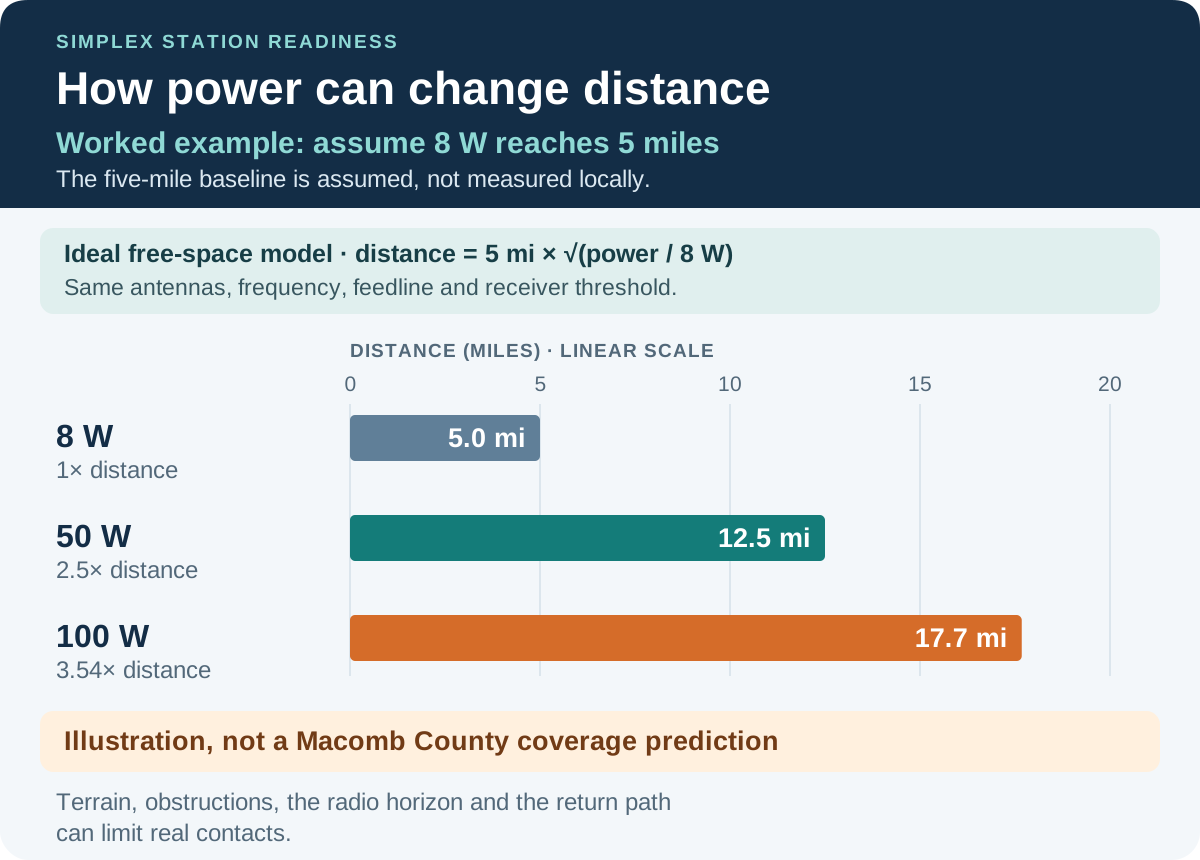
| Transmit power | Example distance | Distance vs. 8 W |
|---|---|---|
| 8 W | 5.0 miles | 1× |
| 50 W | 12.5 miles | 2.5× |
| 100 W | 17.7 miles | About 3.54× |
This assumes range is limited by signal strength on an unobstructed path. It does not account for terrain, buildings, ground reflections, interference, or the radio horizon. If a hill or low antenna is already limiting your path, turning up the power may add little usable distance. The other station must also be able to reply.
Distance calculation and source
Example distance = 5 miles × √(power ÷ 8 watts). This square-root relationship follows from the free-space attenuation formula in ITU-R P.525-5, section 2.3. The ITU supplies the propagation model; the five-mile baseline is our teaching assumption. These distances are not a Macomb County coverage prediction.
See the original power comparison: 8, 50, and 100 watts
More power can help a marginal signal become readable. The comparison below isolates transmit power only: the frequency, antennas, antenna heights, feed-line losses, and path stay the same. It does not compare complete real-world installations.
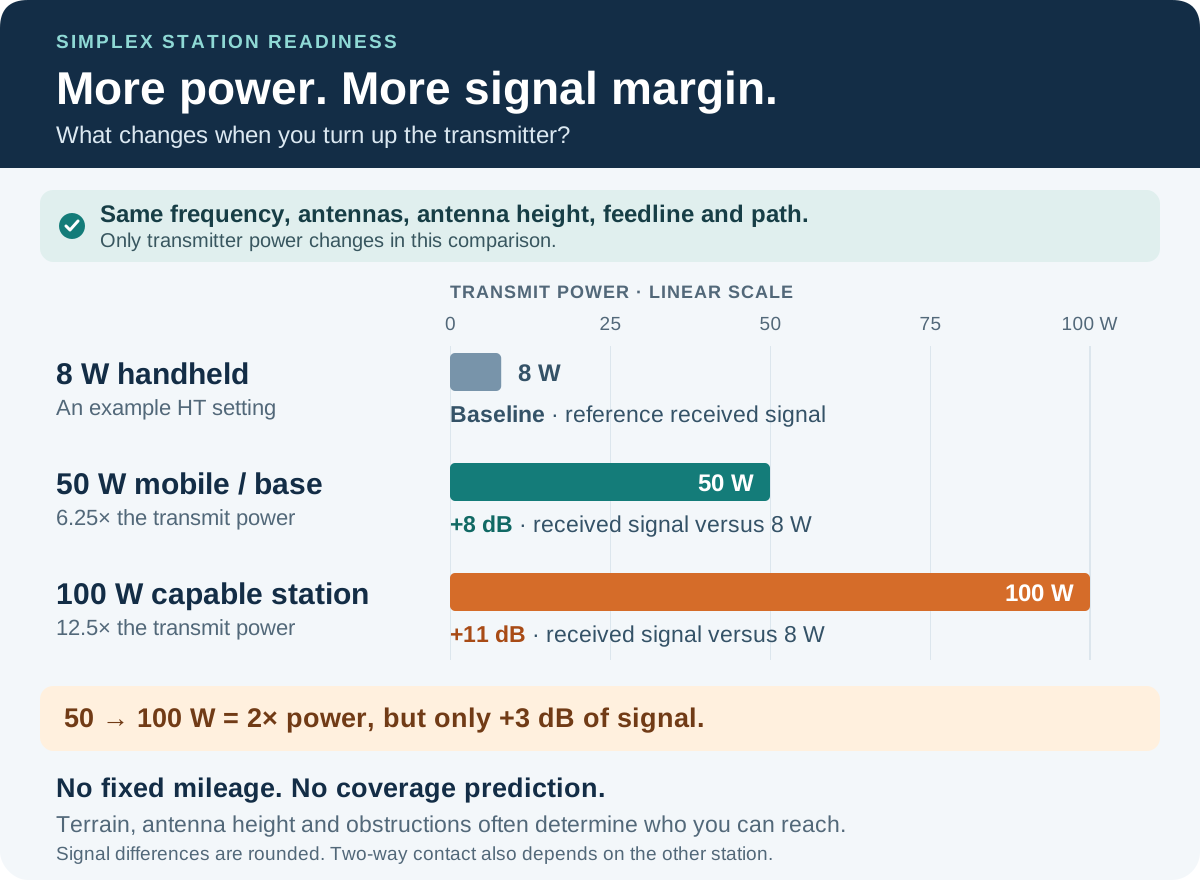
| Transmit power | Power vs. 8 W | Received signal vs. 8 W |
|---|---|---|
| 8 W | 1× | Reference (0 dB) |
| 50 W | 6.25× | About +8 dB |
| 100 W | 12.5× | About +11 dB |
Moving from a 5-watt handheld to 50 watts is a 10 dB increase with everything else held equal. Going from 50 to 100 watts adds just 3 dB; it does not double your range. The 100-watt example is a comparison point, not a requirement or a power level available on every VHF/UHF radio.
Calculation: gain in dB = 10 × log10(new power ÷ reference power). See ARRL's guide to decibels (PDF).
What changes those distances in the real world?
There is no dependable mileage rating for 8, 50, or 100 watts. For local VHF/UHF FM, antenna height, terrain, buildings, vegetation, feed-line loss, and noise at the receiving station all affect the result. More watts cannot reliably fix a blocked path.
ARRL illustrates the difference with a low-power handheld: contacts may be only a few miles across flat terrain, yet a handheld on Pikes Peak can reach 100 miles. Those are terrain examples, not expectations for Macomb County. Read ARRL's explanation of height and antennas.
Antenna height changes the radio horizon
These calculated examples show how raising the antennas changes the horizon over smooth ground. They are not predicted contact distances for any power level.
Assumes smooth Earth and standard atmospheric refraction. Hills, buildings, trees, antenna performance, interference, and signal strength are not included. Actual contacts may fall short of or extend beyond these horizons. Heights are illustrative; they do not represent the EOC.
How these examples were calculated
Approximate radio horizon in statute miles = 1.41 × (√h1 + √h2), with antenna heights in feet. This is the effective-Earth-radius formula with a 4/3 Earth-radius factor, converted to feet and miles. See NTIA TR-01-383, page 4-12, equations 4.18–4.19 (PDF).
Try a coordinated simplex check
- Agree on the plan. Arrange a time and the locally assigned simplex frequency with net control or another member. Coordinate EOC participation; do not assume it is monitoring. Confirm simplex operation with no repeater offset.
- Use your real operating location. Test from home or the place you expect to serve. Record the radio, power setting, antenna, and approximate antenna height.
- Exchange messages both ways. Start at low power, compare higher settings if needed, and report whether speech is clearly readable. Keep antenna and location unchanged when comparing power.
- Improve the path. Try a clearer location or a better antenna position. If direct contact fails, identify a station that can hear both ends and practice a relay.
- Repeat on backup power. Verify that the radio can transmit without the supply voltage sagging. Record the result and retest after station changes.
Keep a simple station test record
Date/time • frequency • both stations and locations • power at each end • antennas/heights • readability in each direction • battery or utility power • direct or relayed • next improvement.
Choose one improvement for the next year
- Antenna first: improve its location, inspect connectors, and reduce unnecessary feed-line loss. An external antenna can also extend an HT's usefulness.
- Add station capability: consider a 50-watt-class mobile or home setup, with an antenna and power source suited to the job.
- Make power dependable: size backup power for the radio's actual current draw and expected transmit/receive time. RF output watts are not the same as battery consumption.
- Build a proven plan: program the agreed simplex channels, identify a relay partner, and repeat the test under different conditions.
A lesson from another ARES group
After simplex difficulties during Winter Field Day in 2024, Alachua County ARES planned eight simplex nets, including relayed check-ins. Their approach offers a practical lesson: find the gaps during practice and build the relay plan.
ARRL ARES Letter — April 17, 2024A handheld still makes a difference
Near Orofino, Idaho, in September 2024, an amateur used a handheld on 146.52 MHz after a four-wheeler accident where there was no cell service. Another operator heard the call, contacted 911, and relayed updates. The report gives no distance or transmit power.
ARRL Letter — October 3, 2024Bring the station you have. Plan the station you need.
A handheld belongs in the plan. So do effective antennas, backup power, capable mobile and home stations, and practiced relays. The goal is a verified way to pass a message when the repeaters are unavailable.
Check-In List
| # | Call Sign | Unit # | Name | City | Member |
|---|---|---|---|---|---|
| 1 | N8VDZ | 2 | Mike | Warren | — |
| 2 | KE8WUO | 20 | John | Warren | Member |
| 3 | K8WA | 19 | Bill | Warren | Member |
| 4 | W8VOX | 30 | Jon | Macomb | Member |
| 5 | N8CAF | 26 | Cliff | Clinton Township | Member |
| 6 | W8BPD | 24 | Brian | Warren | Member |
| 7 | N8WCB | 6 | Dave | Sterling Heights | — |
| 8 | AD8MP | 35 | David | Saint Clair Shores | — |
| 9 | N8XZ | 5 | Ron | Warren | — |
| 10 | KE2BNY | 47 | Devin | Warren | — |
| 11 | N8BZR | 27 | Brian | Harrison Township | — |
| 12 | N8KJV | 38 | Jason | Warren | — |
| 13 | KF8FQZ | 41 | Lisa | Warren | — |
| 14 | KF8FRA | 44 | Peter | Warren | — |
| 15 | KF8FGS | 32 | David | Utica | — |
| 16 | KE8YNU | 1 | Dave | New Haven | — |
| 17 | N8WRO | 10 | Tim | Richmond | — |
| 18 | KF8ETQ | 23 | Darren | Fraser | Member |
| 19 | KA8UHG | 28 | Steve | Saint Clair Shores | — |